




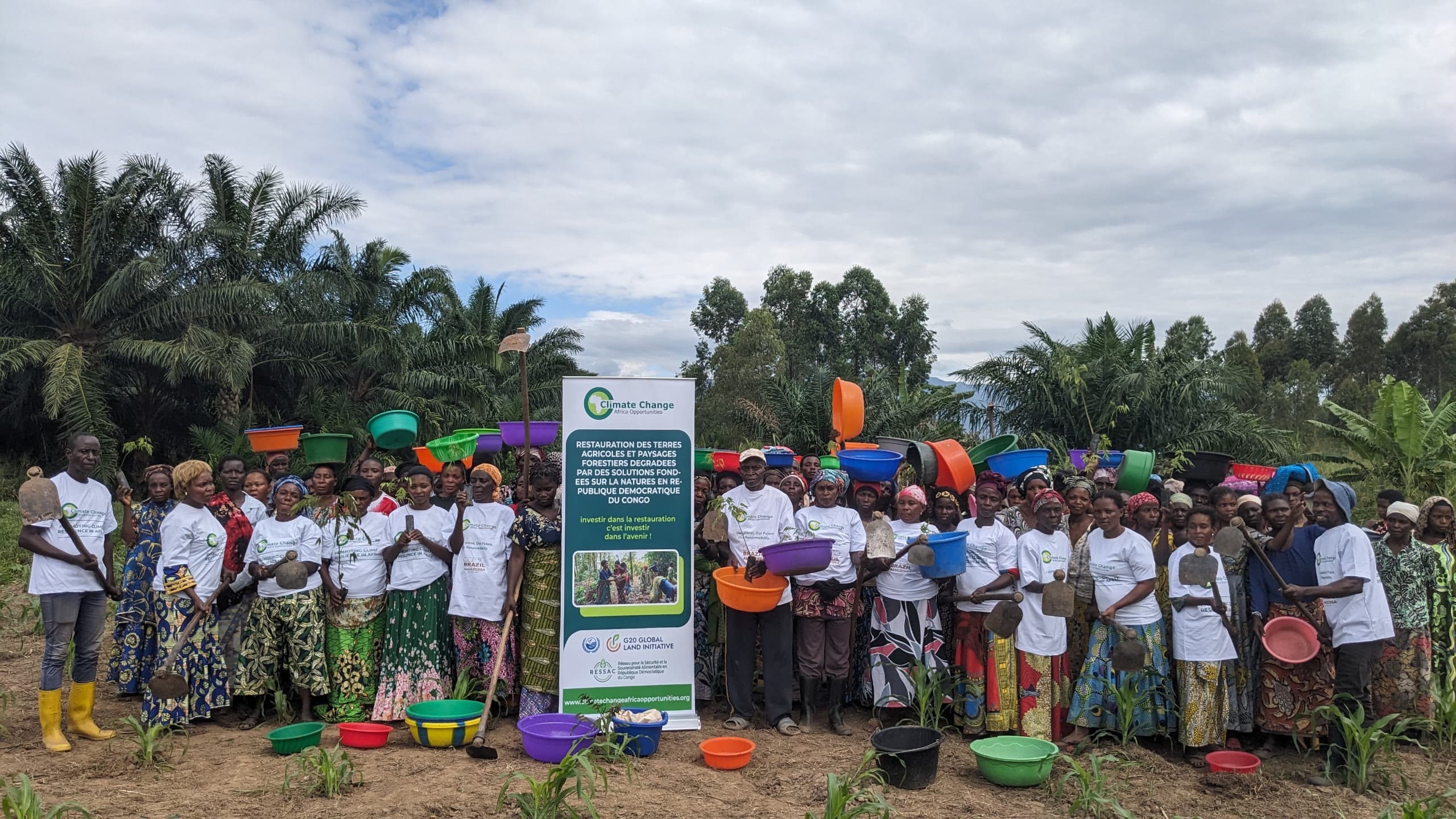
When the rain withdraws, the soil gives out
For more than three decades, communities across Mwenga Territory have watched rainfall decline sharply. The consequences are written into the fields: degraded, impoverished soils no longer capable of producing enough to feed rural households.
The causes are well documented — community practices that place ecosystems under strain, rising greenhouse gas emissions, and, critically, the shortage of technologies suited to soil protection and restoration together with limited access to seed varieties able to withstand new climate conditions. It is on those last two that action is possible.
The Democratic Republic of the Congo has committed to restoring 8 million hectares of degraded and deforested land by 2030 — its national contribution to the Bonn Challenge, which targets 350 million hectares restored worldwide by the same date. That commitment will only become real if it is carried, village by village, by organisations rooted in the communities themselves.
This is the role CCAO has taken on.
A project designed and delivered by CCAO
CCAO built its intervention on a single conviction: land cannot be restored for the long term without first restoring the relationship communities have with it.
The organisation therefore structured its work around three complementary pillars:
- Understand — bring 500 farmers to grasp the realities of climate change and its direct connection to their own farming practices;
- Restore — promote Nature-based Solutions (NbS) and strengthen the capacity of 22 farmer organisations to apply them;
- Supply — establish a participatory, multi-stakeholder mechanism guaranteeing farmers reliable access to climate-adapted seed.
Results that can be counted — and seen
Mindsets have shifted
Following the awareness-raising and mentoring work led by CCAO:
- 81% of farmers can now explain the link between their environmental behaviour and global warming — and have adopted practices that protect the environment, while encouraging others around them to do the same;
- 79% of farmer organisations have established local environmental management agreements and enforce them themselves.
The land is coming back
- 72,734 climate-resilient trees planted during 2025;
- 181 hectares of farmland regenerated through area closure (mise en défens) and Assisted Natural Regeneration (ANR);
- 3 hectares of woodlot planted in each of the 22 target villages, in support of the national reforestation campaign;
- 72% of farmers have adopted the package of technological innovations for sustainable soil fertility management.
Seed is finally circulating
- 2 meetings held per zone bringing together farmers, research institutes and the private sector on climate-resilient seed;
- 1 participatory, multi-stakeholder seed supply mechanism established in each intervention zone;
- 17 tonnes of improved seed — beans, maize, cassava, sweet potato, potato, sorghum and groundnut — made available to members of farmer organisations.
What the figures actually mean
Behind the 181 hectares regenerated are families who have a harvest again. Behind the 17 tonnes of seed are growing seasons that no longer depend on chance. And behind the 72,734 trees is a rebuilt natural asset that will protect these soils long after the project itself has closed.
CCAO deliberately chose an approach that equips communities rather than standing in for them: management agreements drafted by farmers themselves, agroecological techniques transferred and genuinely taken up, seed systems run by local actors. That is the condition for gains to outlive the project.
What comes next
CCAO is continuing its work in Mwenga Territory and intends to extend this approach to new areas. The organisation invites technical and financial partners, government services, research institutes and the private seed sector to join the effort.
Restoring 8 million hectares by 2030 is a national goal. CCAO is demonstrating, hectare by hectare, that it can be met.


.png)