




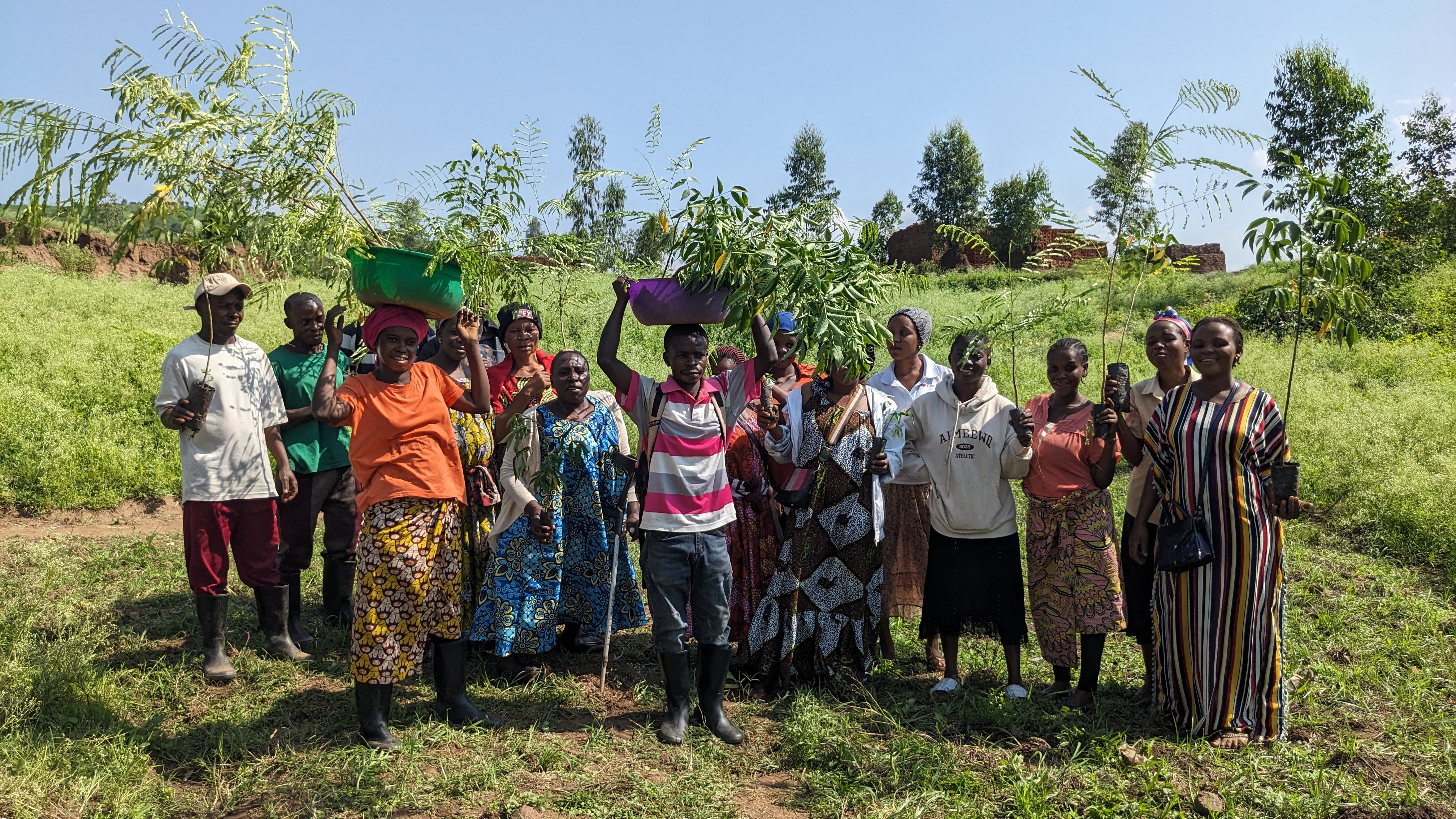
Kinshasa, Democratic Republic of the Congo — On the edge of the Congolese capital, in the rural commune of Maluku, CCAO has just completed one of the most significant forest restoration operations ever carried out around Kinshasa: 687 hectares of degraded forest restored, 274,944 trees planted and 100 permanent green jobs created across ten villages of the Batéké plateaux.
A food basket undermined by its own growth
The Batéké plateaux feed Kinshasa. The villages of Bu, Kikimi, Mbankana, Mongata, Mwe, Ngana, Nguma, Sualemputu, Menkao and Yuwo form a string of agroforestry communities that supply a substantial share of the megacity’s food and fuel — chiefly cassava and charcoal.
Yet that very role has turned against the land. Driven by rapid population growth, small-scale farming has come to overexploit the forests and natural resources it itself depends on. The consequences are already visible: soil degradation, falling agricultural productivity, landslides and mudslides, and a decline in both the quality and the supply of drinking water.
Compounding this are the loss of tree cover, the removal or alteration of understorey vegetation, forest clearance, human-induced fires, and soil compaction from livestock grazing — all factors that sharply increase the risk of soil erosion across the plateaux.
CCAO’s response: restore the land, root the work in the community
In response, CCAO designed and implemented a project built around two inseparable objectives.
The first is ecological: restoring the degraded forest areas of the ten target villages through the planting of soil-fertility species, traditional forest species and fruit trees, in order to turn exhausted land into resilient production units.
The second is institutional and social: embedding that restoration durably within the communities by creating 100 permanent green jobs, with young women and Indigenous women as the priority beneficiaries, delivering a lasting improvement in their socio-economic conditions.
What CCAO delivered on the ground
100 young people and Indigenous women trained and employed. CCAO identified and selected 100 young people and Indigenous women as nursery growers and forest monitors across the ten villages. All received capacity-building in degraded-ecosystem rehabilitation techniques, nursery management, the sound and sustainable management of resources, and the tracking and monitoring of degraded forest landscapes.
Ten village nurseries established and equipped. One nursery per village, with a combined production capacity of 300,000 seedlings. These facilities form the technical backbone of the project and remain in the hands of the communities.
687 hectares restored, 274,944 trees planted. The restoration was carried out by local people themselves — in particular young people and women smallholder farmers. The soil-fertility, traditional forest and fruit species planted strengthen the landscape’s ecosystem services over the long term: carbon storage, water filtration, soil retention and, ultimately, community well-being.
A replicable model
By entrusting seedling production, planting and forest monitoring to the communities themselves, CCAO opted for a model in which restored forest becomes a local economic asset rather than an externally imposed constraint. It is this combination — ecological restoration paired with permanent green employment — that gives the Batéké plateaux project its demonstrative value for degraded peri-urban belts across the Democratic Republic of the Congo.
Villages covered: Bu, Kikimi, Mbankana, Mongata, Mwe, Ngana, Nguma, Sualemputu, Menkao and Yuwo (Maluku rural commune, Kinshasa).
Project designed and implemented by CCAO.


.png)